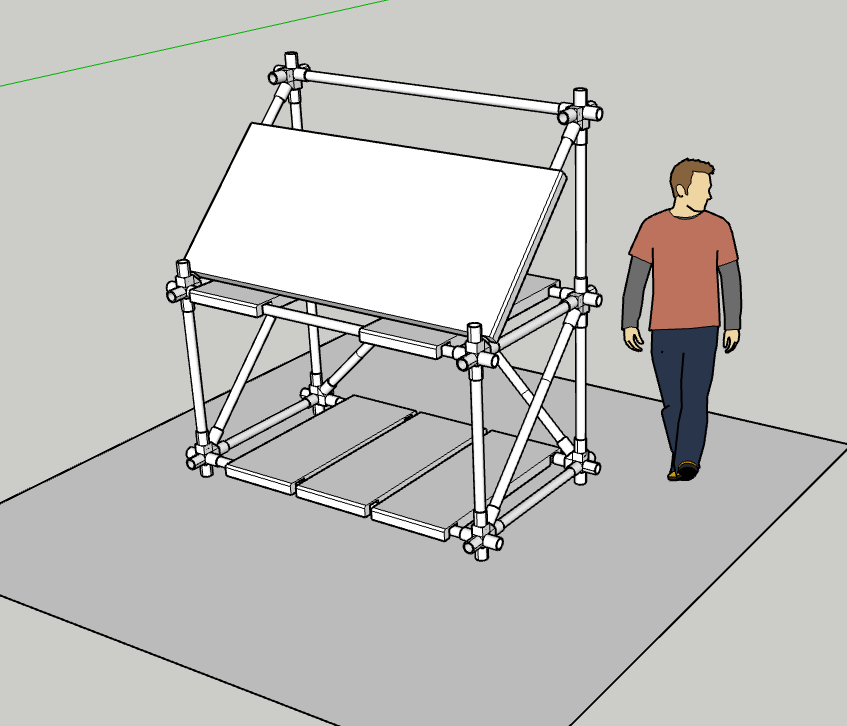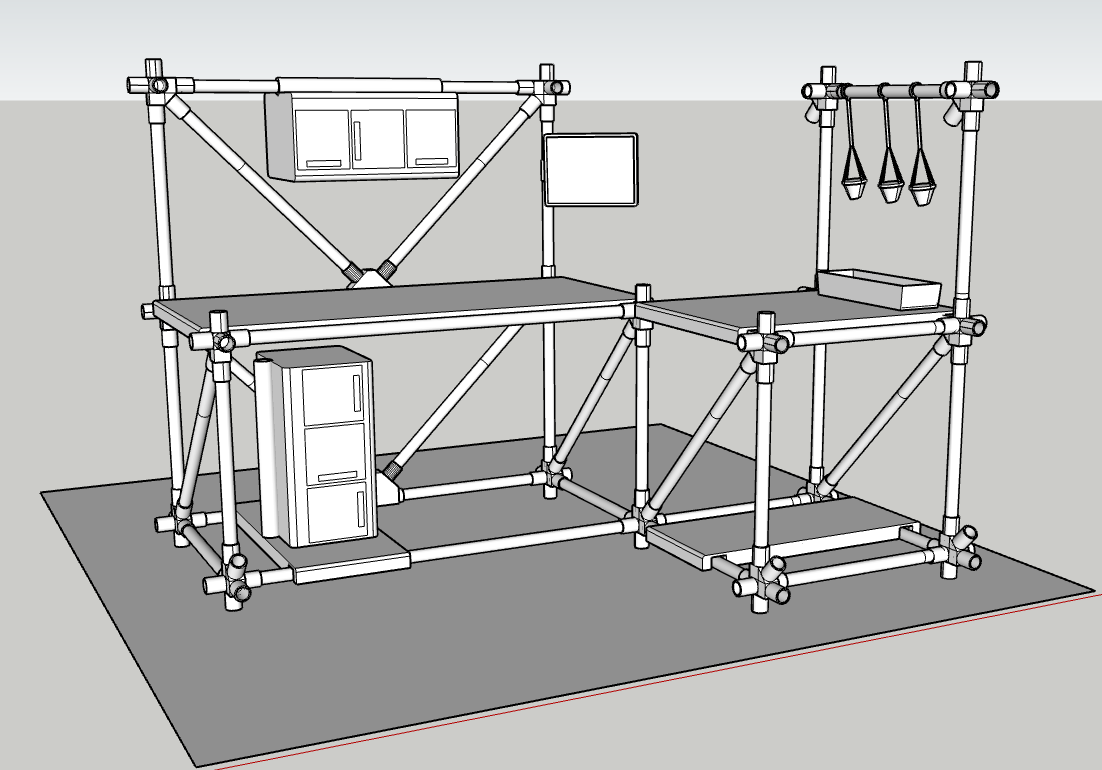
The Tange Desk is named after Kenzo Tange, a prominent 20th-Century Japanese architect whose work and philosophy inspired his proteges to create the Metabolism movement. The Tange Desk is likewise inspired by the works and beliefs of Mr. Tange - and some of his students.
Although called a "desk," the Tange Desk is really more of a modular office suite. It is built from a series of interchangeable bamboo poles, joints, and modules that allow a single collection to act as multiple types of furniture: desk, storage, table, possibly even chair (though I haven't included any modules for seating in this version). Functioning like a LEGO set (technic, specifically), the pieces grant the user free reign to construct their perfect office set-up - again and again and again, should the user's needs and desires change. The K-joints inevitably remain open at the terminating points, inviting the user to consider who the Tange Desk might be expanded in the future. It never appears fully finished, because it never is; it only changes, grows, expands, or retracts.
Unique modules for the Tange Desk include different sizes of surface, hanging planters, and an adjustable arm for holding computer monitors. The storage compartments can be hung on the poles or sat on a surface, and their two-directional door design encourages the user to experiment with different vertical and horizontal configurations. The entire thing can be constructed from only a few different lengths of bamboo pole, creating all sorts of potential configurations. Future expansions to the Tange Desk may include more sizes of pole, different joint types, and brand new modules for different tasks.